
The Blade: a free daily AI & semiconductor supply chain newsletter
SpaceX lines up US$40bn of debt for NVIDIA GPUs; Musk says neoclouds will consolidate
Zero One Investment Research Daily Intelligence Brief, October 26, 2026
SpaceX lines up US$40bn of debt for NVIDIA GPUs; Musk says neoclouds will consolidate
Top Market Signals
SpaceX raising US$40bn for NVIDIA chips arriving 1H27
SpaceX has raised US$40bn of debt mainly to pay for NVIDIA (NVDA US) GPUs arriving in 1Q27 and 2Q27, Elon Musk said on X on 25 Oct. He credited the company's investment-grade credit rating and revenue from Starlink and rocket launches, and said the debt can be repaid early and has little effect on this quarter's results.
It is not yet clear what "completed" means, or whether investors have agreed on pricing, Reuters reported. Goldman Sachs is leading the banks and is in talks with investors led by Apollo to raise the money through a special purpose entity, TechNews reported, so the debt does not sit on SpaceX's own balance sheet. That structure is meant to avoid a repeat of xAI's financing last year, when about US$13bn of debt ended up on its books.
Musk also said debt markets have almost fully cut off funding to companies without substantial revenue, and predicted heavy consolidation and failures among neoclouds, the newer cloud firms such as CoreWeave (CRWV US) and Nebius (NBIS US) that rent out AI computing capacity. He said SpaceX will not buy any of them. Investors have already started shorting US neoclouds and data center companies, CNA reported.
Our 21 Oct Blade covered SpaceX's 3Q26 results, when revenue rose 161% YoY to US$14.6bn and the CFO guided this quarter's infrastructure spending to US$35-40bn. Today's deal shows how the next leg is funded: a buyer with launch and satellite cash flow can borrow against it for GPUs, while Musk says the market is closing to buyers without that revenue. If that holds, access to debt would decide which smaller buyers can take NVIDIA GPUs in 2027.
Linked stocks: NVDA US, CRWV US, NBIS US
Hinges cap Apple's 30% larger foldable iPhone order
Apple (AAPL US) has asked suppliers to speed up output of the iPhone Duo, its first foldable phone, and has added about 30% to its orders after every model sold out on launch day, 23 Oct, Economic Daily News reported. The next shipments are not due until 22 Jan 2027.
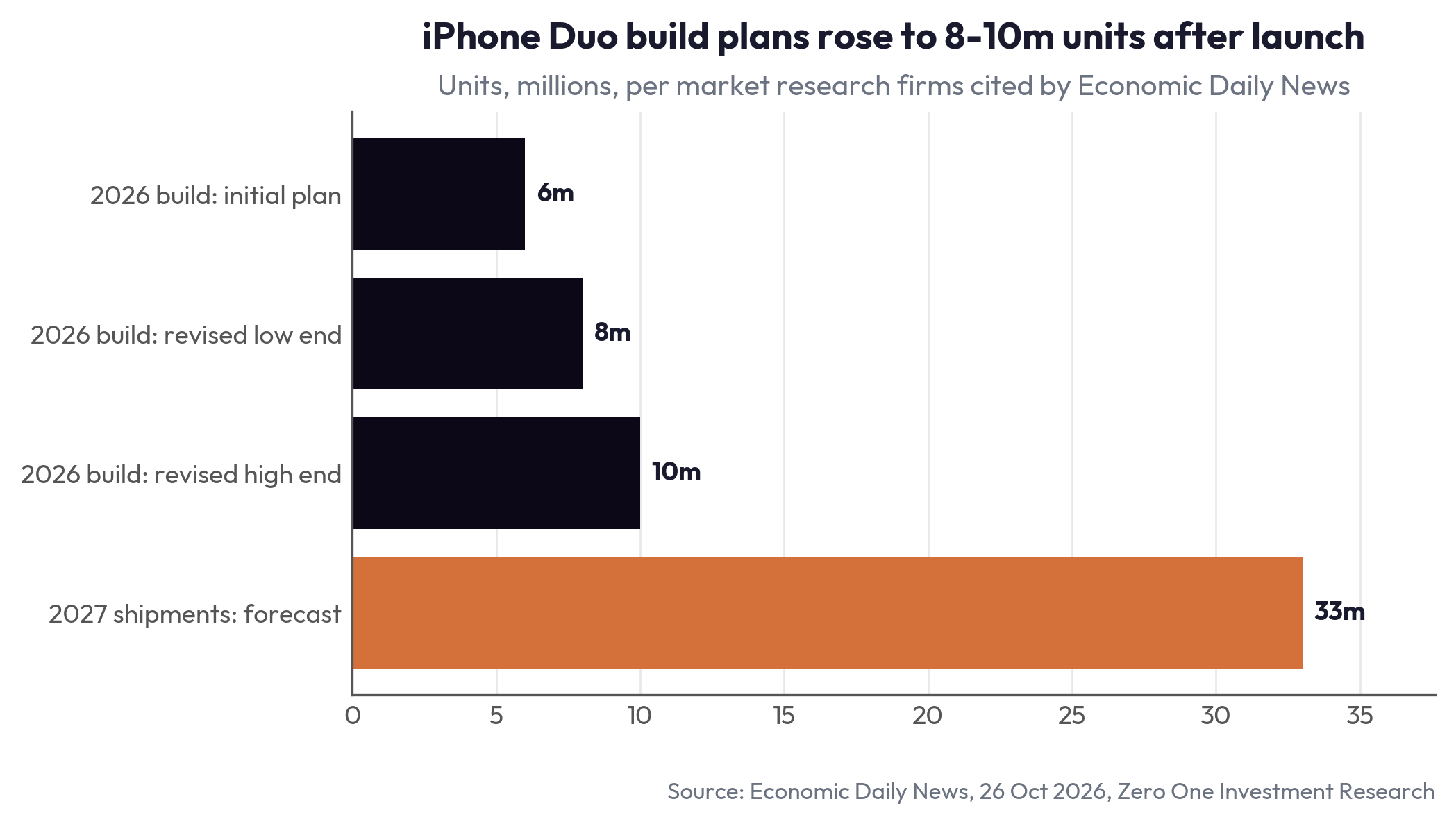
Market research firms now expect 8m to 10m units to be built this year, up from 6m, and see 2027 shipments reaching 33m, which would give Apple about 40% of the global foldable market next year. Foxconn (2317 TT) assembles every unit and TSMC (2330 TT) makes the processor. The hinge, the most important part, comes from a joint venture between Foxconn and Shin Zu Shing (3376 TT), with Amphenol (APH US) as the second supplier.
Industry sources told the paper that hinge capacity and the difficulty of assembly are what limit supply. The same part is the leading suspect in early reports of cracked screens. iFixit's teardown found a hinge section that sometimes does not seat properly, with a folding cable running over that spot, and a Korean reviewer found a broken hinge piece lined up with where a crack started. The failures are still rare: AppleInsider found one case across seven Apple stores it checked.
Our 12 Oct Blade reported that Apple's chief operating officer toured Foxconn's iPhone Duo line in Zhengzhou amid talk of yield problems. Hinge yield now decides how many units ship this year and, if the teardowns are right, how many come back.
Linked stocks: AAPL US, 2317 TT, 3376 TT, APH US
NVIDIA puts a yearly price on its agent software
NVIDIA (NVDA US) chief executive Jensen Huang said the company's software for running AI agents costs about US$2,000 per GPU per year, and that software licensing will become an increasingly large part of NVIDIA's business. He made the comments at GTC Berlin on 22 Oct, Tom's Hardware reported.
The figure turns part of every GPU sale into a yearly fee. At US$2,000 a GPU, five million paid licenses would bring in US$10bn a year, though NVIDIA has not said how many GPUs the fee would cover or whether it is a standard price. Its existing AI Enterprise software lists at US$4,500 per GPU for a one-year subscription, and NVIDIA has not said whether the two prices cover the same products, so this should not be read as a price cut.
Our 20 Oct Blade covered Amazon's (AMZN US) tool that lets AI apps written in PyTorch run on its own Trainium chip with a one-line change, and our 23 Oct Blade covered Meta running Google's (GOOGL US) TPU chips in production. Rivals are making it easier to move AI code off NVIDIA hardware, while NVIDIA is pricing the software that manages agents on that hardware. How many customers pay for it will show whether that layer holds when the chips underneath can be swapped.
Linked stocks: NVDA US, AMZN US, GOOGL US
Socket standard lets failed optical engines be swapped
The Open CPX MSA, an industry group whose Specification 1.0 lists Ciena, Coherent, Marvell (MRVL US), Molex, Samtec and Terahop as main participants, has published the first common design standard for co-packaged optics (CPO), which places the optical engines that turn electrical signals into light right next to a switch or AI chip, Economic Daily News reported. The standard makes those engines pluggable.
Most CPO designs today solder the optical engine beside the chip package, so one failed engine scraps the whole package, and every vendor uses different pin layouts. Under the new standard, a socket sits on the package substrate and the optical module connects into it. The same socket can also take a copper cable connector, which gives buyers a fallback until optical module yields improve.
The standard defines two socket layouts and two laser options, an external or an internal laser module, for four combinations. The socket choice is fixed once made, while laser modules can be swapped. The spec sets only the interface, so engine design and materials stay with each maker, and competition shifts to engine performance and reliability.
Analysts cited by the paper named socket makers Foxconn Interconnect Technology (6088 HK) and Lotes (3533 TT) as the most direct beneficiaries, along with fiber array unit suppliers Foci (3363 TT) and Browave (3163 TT). Our 22 Oct Blade named Foci as an NVIDIA-certified supplier for its CPO switches.
Linked stocks: 3533 TT, 6088 HK, 3363 TT, MRVL US
SK hynix weighs paying out its Kioxia windfall
SK hynix (000660 KS) plans to return about 80% of the profit from selling its Kioxia (285A JT) stake as a special dividend of about KRW16tn (US$12.1bn), Dong-A Ilbo reported, citing investment banking sources. SK hynix said nothing has been finalized, and its shareholder return plan is due with 3Q26 results on 28 Oct.
SK hynix sold the Kioxia holdings in 1Q26 and 2Q26 for a net gain of about KRW20tn after the original cost, Commercial Times reported. The stake dates to Bain Capital's 2018 purchase of Toshiba's memory business. The dividend would come on top of a buyback of about KRW40tn announced in August, about 3.3% of shares outstanding, all to be cancelled, which SK hynix completed on 21 Oct, nearly a month early.
The company has also said the share of 2025-2027 cumulative free cash flow it returns will no longer be capped at 50%. At the same time it has dropped plans for a US listing of its Solidigm storage unit, as our 23 Oct Blade noted, so it is handing cash back rather than raising it. The 28 Oct plan will show whether the dividend is confirmed and how much of the Kioxia gain it uses, while SK hynix still plans a US fab for Solidigm.
Linked stocks: 000660 KS, 285A JT, 005930 KS
Intel aims for 10% of revenue from packaging
Intel (INTC US) chief executive Lip-Bu Tan said he wants to build new businesses that each bring in 10% of revenue, and named three: custom chips (ASICs), physical AI (AI for robots and machines) and advanced packaging. He spoke at the Chinese American Semiconductor Professional Association's annual dinner in Silicon Valley on 24 Oct, CNA reported.
On EMIB-T, Intel's method of linking chips through a small silicon bridge set into the package substrate, Tan said Intel has the best technology and needs to focus on capacity, yield and production cycle time. He also said progress on Intel's 14A process is very strong. This year Intel hired Eric Demers from Qualcomm for GPUs and former SK hynix chief executive Lee Seok-hee, who brings HBM (high-bandwidth memory) experience.
Our 23 Oct Blade cited TrendForce saying Intel's new products face process and packaging delays and its own capacity is tight. Tan's list of what packaging still needs matches those limits. Intel reports 3Q26 results on 29 Oct after the US close, where outside foundry customers and the 4Q outlook are the open items.
Linked stocks: INTC US, 2330 TT, 3711 TT
先聲 First Word: Exclusives from Chinese-Language Sources
Indium phosphide shortage tops 30%, laser material makers say
Supply of indium phosphide substrates and epitaxial wafers, the base material for optical communication lasers, is short by more than 30%, and Visual Photonics Epitaxy (2455 TT) said it lacks the material to make wafers, not the orders. LandMark Optoelectronics (3081 TT) and Visual Photonics are adding capacity, so laser output for faster optical modules depends on substrate supply. (26 Oct 2026) Source: 光通訊商機後市看俏 磷化銦短缺 業界傷腦筋
AI shipments push Taiwan to US air freight to a 2026 high
Rush air cargo rates from Taiwan to the US have passed NT$400 per kg, up more than 10% and the highest this year, as US carriers flew nearly 100 charter flights to Taiwan last month for AI servers and chip equipment. EVA Air (2618 TT) said AI cargo has no off-season; its September cargo revenue rose 42.55% YoY to NT$6.17bn. (26 Oct 2026) Source: AI 業搶貨 航空運價急漲一成 長榮航:還有調升空間
AI equipment orders keep Taiwan's motion part makers on overtime
HIWIN (2049 TT), Hiwin Mikrosystem (4576 TT) and PMI (4999 TT), which make ball screws and linear guides for machine tools, have at least six months of order visibility and are running overtime on AI server, circuit board and chip equipment demand. Tongtai (4526 TT) has some board drilling machine orders reaching 1H28, so AI board capacity spending now reaches machine tool suppliers. (26 Oct 2026) Source: AI紅利外溢 傳動元件廠爆單趕工

© 2026 Zero One Investment Research Pte Ltd. For informational purposes only. Not investment advice.