NVIDIA sends credit deals to its board as TSMC sizes customers by balance sheet
Zero One Investment Research Daily Intelligence Brief, November 16, 2026
NVIDIA sends credit deals to its board as TSMC sizes customers by balance sheet
Top Market Signals
NVIDIA sends new credit deals to its board
NVIDIA (NVDA US) is reviewing its whole program of financing and credit support for the AI industry under interim chief executive Colette Kress, TechNews reported. It has paused parts of the program and told customers that new credit commitments must pass senior management and board review, so they can no longer be agreed quickly.
The program let AI cloud firms and data center developers borrow from banks against NVIDIA's backing, then spend the money on NVIDIA chips. It drew interest from dozens of companies within weeks of its 2026 launch. The risk is that NVIDIA owes billions of dollars if those customers cannot repay. The Ohio data center planned for OpenAI shows the scale: after reports in late July of a guarantee of up to US$250bn, Kress renegotiated it down by half, and the smaller deal was signed in mid-August.
Our 13 Nov Blade reported Kress's record of opposing Huang's largest financing deals. The new step is process: credit now goes through the board. Commercial Times reports suppliers expect the effect to fall on neocloud projects (smaller AI cloud firms) that depend on outside financing, which could be delayed, while the largest cloud companies pay from their own capex and are less exposed.
NVIDIA reports 3Q FY27 results on 17 Nov, the first chance for management to say how much of the program continues.
Linked stocks: NVDA US, CRWV US, NBIS US
TSMC sets customer credit limits by balance sheet
TSMC (2330 TT) sets a credit limit for each customer from its balance sheet, historical loss rate, competitiveness and outlook, and an order above that limit must be paid for in cash, Commercial Times reported, citing companies in the chain. Some customers also prepay to reserve capacity. TSMC held NT$234.23bn of customer prepayments at the end of June.
Chairman C.C. Wei has said capacity planning weighs cloud companies' capex, finances, power supply and parts supply, and that TSMC sends staff to the US to check data center construction. TSMC does not, in principle, allow customers to sublet or auction capacity they have booked.
That makes balance sheets the limit on how much the custom-chip designers can buy. They pay for wafers as soon as they come out, then wait for advanced packaging, and are paid only when customers receive finished chips, so the cash gap grows with volume. All three Taiwanese designers have raised money. MediaTek (2454 TT) priced a US$3.9bn zero-coupon convertible bond on 31 Aug, of which NVIDIA bought US$3.5bn. Global Unichip (3443 TT) approved up to US$800m of convertible bonds and signed a NT$40bn bank loan on 30 Oct. Alchip (3661 TT) raised US$510m in June.
The designers expect large AI projects to get supply first and smaller projects to be squeezed hardest.
Linked stocks: 2330 TT, 2454 TT, 3443 TT, 3661 TT
US remote-access chip rule starts in 90 days
The US Commerce Department's Bureau of Industry and Security issued an interim final rule on 16 Nov that limits remote access to advanced AI chips and servers through data centers in third countries. It also requires a license to export, re-export or transfer advanced chips in Indonesia, Malaysia, Singapore, Thailand and Brazil. The requirements take effect in 90 days, Tom's Hardware reported.
Our 14 Nov Blade reported a draft covering seven countries, including Norway and South Africa. Those two are not in the five named in the issued rule. US-headquartered companies and some commercial recommendation-system uses are exempt, Economic Daily News reported. Commerce said the Treasury and the National Security Council drafted the rule and directed it be made.
The exposure is hard to size. Barron's put NVIDIA's China revenue at US$12.4bn for the half year to 26 Jul, 7% of the total, much of it likely from unrestricted PC and auto products. NVIDIA reports revenue by the headquarters of its direct customer, so where its chips end up is hard to read from its reports. Melius Research estimates US$18-35bn of NVIDIA's annual revenue could be at risk from tighter controls.
For Taiwan's server makers, the first effect is on delivery timing for overseas customers waiting on licenses. Treasury Secretary Scott Bessent has given NVIDIA's board and outside counsel ten days to answer whether the company knowingly broke the ban on selling top chips to China.
Linked stocks: NVDA US, 2330 TT, 2317 TT
Google's AI chip orders reach 2029, past NVIDIA's
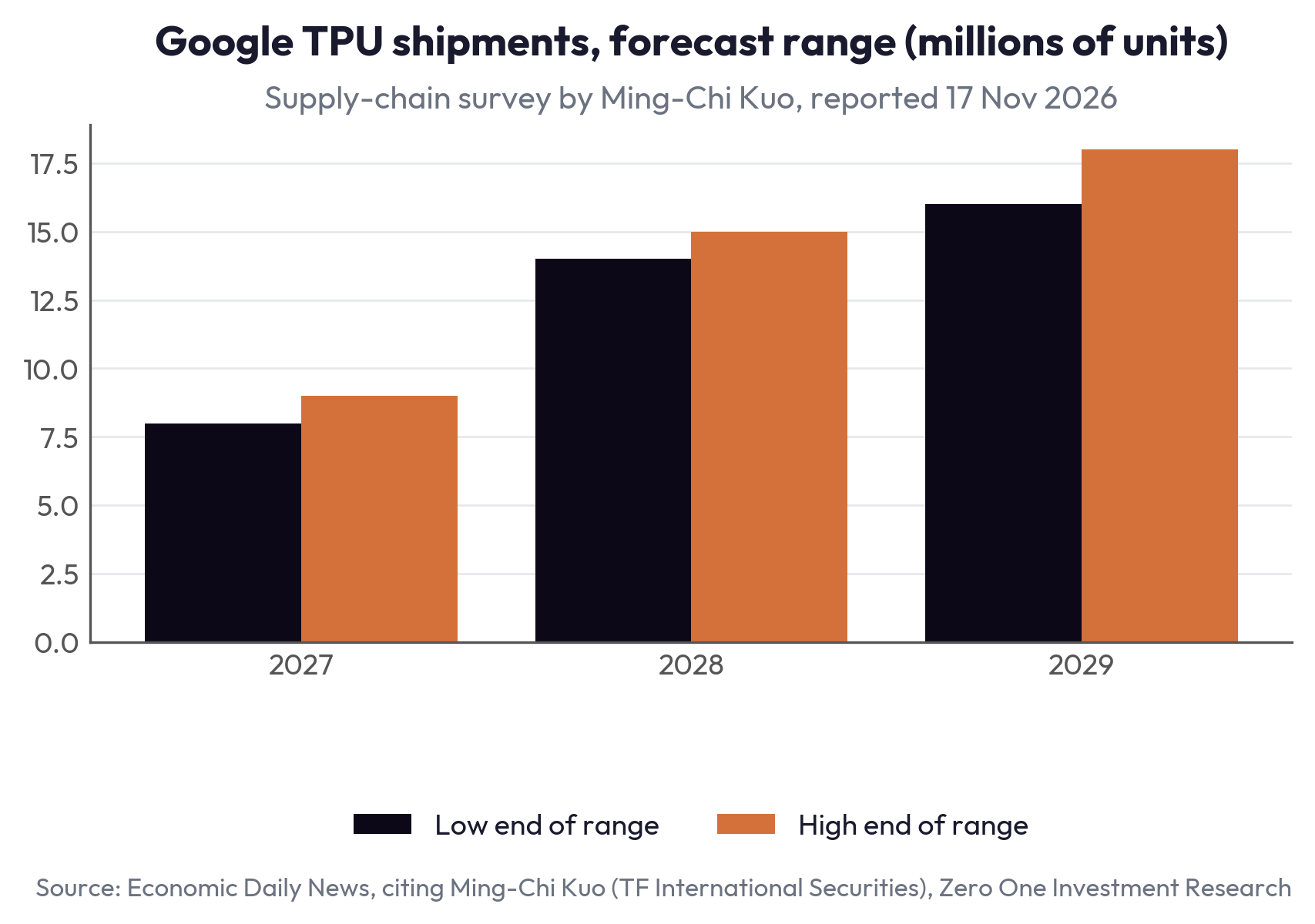
Shipment visibility for Google's TPU (tensor processing unit, its in-house AI chip) now runs to 2029, against 4Q27 to 2Q28 for NVIDIA GPUs and most other custom AI chips, according to a supply-chain survey by Ming-Chi Kuo of TF International Securities, Economic Daily News reported. New orders from OpenAI and Anthropic extend the horizon.
Kuo expects TPU shipments of 8-9m units in 2027, 14-15m in 2028 and 16-18m in 2029. From 2028 Google plans to use its ninth-generation TPU for its own data centers and sell the eighth generation mainly to OpenAI and Anthropic. OpenAI's demand for the MediaTek-designed 8t chip is about 12m units across 2028-2029. Anthropic's demand for the Broadcom-designed 8i is about 14m over the same period.
MediaTek (2454 TT) gains most. It holds the 8t orders through 2029 and the design work on the ninth and tenth generations, and Kuo expects its share of TPU supply to rise from 45-50% in 2027 to 55-60% in 2029. DigiTimes reports its custom-chip unit is becoming the center of decisions inside the group as TPU revenue ramps this quarter.
One limit: from the ninth generation, TPUs use an Intel packaging technology whose early capacity is small, so the eighth generation stays the volume product through 2029.
Linked stocks: 2454 TT, AVGO US, GOOGL US
Huang-exit risk sits in substrate and optics suppliers
Chip industry executives see the risk from Huang's exit concentrated in second- and third-tier suppliers of substrates and optical parts, not in TSMC, Commercial Times reported. They are watching whether those suppliers change the order in which they hand out new capacity, giving AMD (AMD US) and custom AI chip customers more priority.
Huang personally persuaded suppliers to expand and secured NVIDIA's allocations, and the executives count that as part of its competitive edge. Foundry work with TSMC is held in place by long qualification cycles and is hard to switch. Smaller suppliers with limited capacity, where expansion was agreed directly between senior executives, are more exposed to a change in personal relationships. AMD and the custom-chip companies have been pushing hard for 2027 leading-edge and advanced packaging capacity.
Elon Musk wrote on 14 Nov that many of Huang's deals were done on a handshake rather than in written contracts. Korea's science ministry said NVIDIA reconfirmed its plan to supply 260,000 GPUs. A foundry executive said the roadmap through the 2028 Feynman generation is expected to hold. Server suppliers told Commercial Times existing orders are largely set through 1H27, but a slower upgrade cadence after that would cut the price gains new specs bring to cooling and power suppliers such as AVC (3017 TT) and Delta (2308 TT).
Linked stocks: NVDA US, AMD US, 3017 TT, 2308 TT
Samsung pulls its 8-inch foundry exit into 2029
Samsung Electronics (005930 KS) is speeding up its exit from 8-inch wafer foundry work, with plant closures now expected by the end of 2029 rather than 2030, Dealsite reported, as carried by Economic Daily News. Samsung has not confirmed the timing. Samsung is moving resources to 12-inch advanced processes, which cuts global 8-inch supply.
UMC (2303 TT) has a long foundry relationship with Samsung's System LSI unit and is placed to take follow-on orders, analysts said, with higher utilization and pricing. Powerchip (6770 TT) has no direct Samsung orders yet but could gain as other customers book capacity early. DigiTimes reports Korean second-tier foundries DB HiTek and SK Keyfoundry plan to keep expanding as power chip demand grows.
In Texas, Samsung is expanding its Austin plant to make the STM32V8 microcontroller used in Starlink satellites, on an FD-SOI process by 2030, Seoul Economic Daily reported. Its Taylor plant plans 2nm production of Tesla's AI5 chip in 2027 and AI6 in 2028.
Linked stocks: 005930 KS, 2303 TT, 6770 TT
先聲 First Word: Exclusives from Chinese-Language Sources
Elite Material says NVIDIA was never 20% of sales
Elite Material (2383 TT), the largest maker of copper-clad laminate (the base material for circuit boards), filed a statement that NVIDIA has never been more than 20% of its revenue, against a local brokerage estimate of 25-30%. The filing came after its shares closed limit-down at NT$3,795, as investors sold the suppliers seen as most tied to NVIDIA. (16 Nov 2026) Source: 台光電:輝達對台光電的營收占比從未超過20%
TSMC's Arizona plan holds at eight fabs
TSMC (2330 TT) is assessing keeping its Arizona site at eight advanced fabs and two advanced packaging plants, and plans to start Texas with two fabs, aiming to break ground by the end of 2027, supply chain sources told Commercial Times. Taiwanese suppliers' US plans are going ahead unchanged by Huang's exit. (16 Nov 2026) Source: 黃仁勳請辭 二三線料商恐鬆動
Topco plans a Boise site next to Micron
Topco Scientific (5434 TT), a supplier of chipmaking materials and engineering services, is preparing a third US site in Boise, Idaho, Micron's home, after Phoenix and Dallas. Topco already works with Micron in Taiwan and Singapore, so the move follows its largest memory customer's US buildout. (16 Nov 2026) Source: 崇越科技美國布局再擴大 擬設波夕據點就近服務美光

© 2026 Zero One Investment Research Pte Ltd. For informational purposes only. Not investment advice.