
NVIDIA pays a Taiwan tester up front; its China share falls to 34%
Zero One Investment Research Daily Intelligence Brief, October 14, 2026
NVIDIA pays a Taiwan tester up front; its China share falls to 34%
Top Market Signals
NVIDIA prepays KYEC to build US chip testing
King Yuan Electronics (2449 TT), known as KYEC, signed a customer prepayment agreement with NVIDIA (NVDA US) on 13 Oct. NVIDIA pays in advance, and KYEC and its US subsidiary AeternZ Semiconductor Testing build test capacity in the US that is reserved for NVIDIA. The prepayment is repaid through future test fees. Economic Daily News said it is the first time NVIDIA has paid a Taiwan chip supplier up front to build in the US.
Neither company disclosed the amount. KYEC's board approved a US plant of up to US$1.4bn in July, its largest overseas investment in recent years. Texas is the most likely site, with a decision due in one to two months and small-volume operation planned from 2028, Commercial Times reported. Chips would first be packaged with CoWoS (TSMC's chip-on-wafer-on-substrate packaging) in Taiwan and shipped to the US for final testing. Under the new contract structure the parent no longer needs to guarantee the project, so KYEC cancelled a US$300m guarantee line.
The prepayment and the cancelled US$300m guarantee reduce KYEC's exposure on a US build it had already committed to in July. KYEC said a US plant without long-term orders would carry larger operating risk. Testing is getting heavier: analysts estimate NVIDIA's Rubin chips need more than 50% longer test time than Blackwell, and KYEC raised its 2026 capex to a record NT$50bn from NT$39.37bn.
Our 30 Sep Blade reported Samsung Electro-Mechanics funding a KRW6.78tn substrate expansion partly with advance payments from NVIDIA and other technology companies. TechNews cited NVIDIA's US$1.5bn multi-year agreement with Amkor (AMKR US) in July as a precedent for reserving back-end capacity. KYEC adds a Taiwan tester to the suppliers NVIDIA is pre-funding. How much test volume NVIDIA allocates to the US plant will decide its revenue and profit.
Linked stocks: 2449 TT, NVDA US, AMKR US
NVIDIA's China share falls to 34%
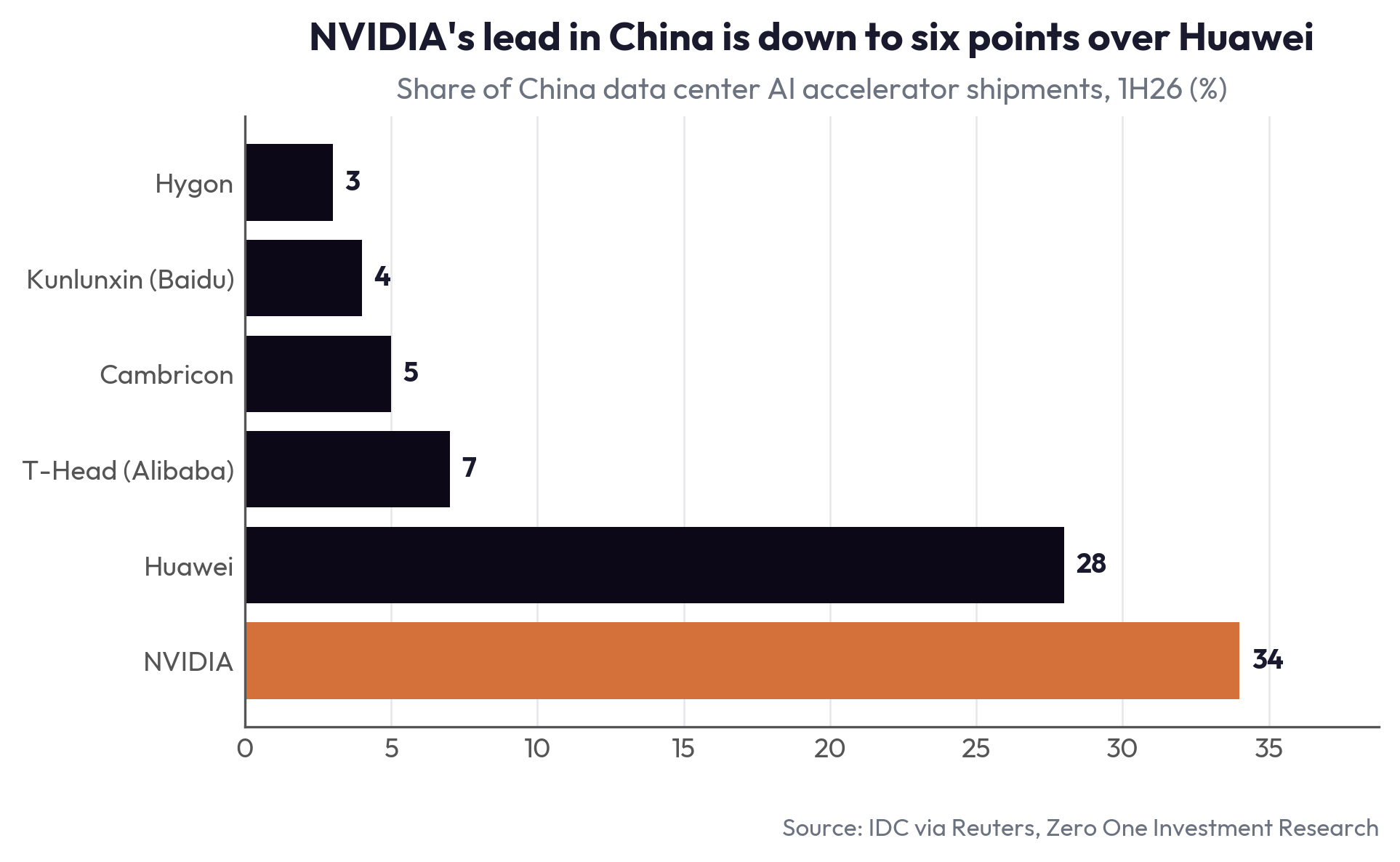
NVIDIA (NVDA US) shipped 678,000 AI accelerators to China's data center market in 1H26, down 44% YoY, cutting its share to 34%, IDC data reported by Reuters show. Huawei shipped 572,000, up from more than 300,000 a year earlier, for a 28% share.
The market itself grew. Total 1H26 shipments in China reached 2.008m units, and 9 of the 11 Chinese chip vendors IDC tracks shipped more than a year ago. Alibaba's T-Head took 7%, Cambricon (688256 CH) 5%, Baidu's Kunlunxin 4% and Hygon (688041 CH) 3%. IDC did not say whether its NVIDIA figure includes B200 and B300 chips, which are banned from export to China but smuggled in.
Chinese buyers are also filling the gap with NVIDIA's own export-compliant cards. Chinese companies have bought more than 1m NVIDIA gaming and workstation GPUs this year, mostly the RTX Pro 6000D and RTX Pro 5000, for simpler AI work, a report cited by Tom's Hardware said. It put China's domestic AI chip output at 3.5m units this year against demand of more than 5m.
NVIDIA CEO Jensen Huang has said US export rules hand a US$50bn China AI chip market to Huawei. The pace at which Chinese output closes its shortfall of about 1.5m chips will decide how much of that demand still goes to NVIDIA hardware.
Linked stocks: NVDA US, 688256 CH, 688041 CH
Samsung ties nearly 80% of 2027 memory to five-year deals
Samsung Electronics (005930 KS) has signed five-year contracts with large technology companies covering close to 80% of its expected 2027 memory capacity, Korean media reported, as carried by TechNews. The contracts cover HBM (high-bandwidth memory, stacked beside AI processors), conventional DRAM and other memory for AI infrastructure, and the main customers include NVIDIA (NVDA US), Google and Microsoft.
Samsung said on its 2Q26 call that almost all of its core customers were pressing for long-term contracts and that it could not meet all demand. The report added that the 80% does not apply to every product, since allocation depends on wafers, packaging, density, yield and qualification. SK Hynix (000660 KS) and Micron (MU US) have also signed major long-term agreements with large customers.
Locking capacity for AI buyers leaves less for the spot and regular contract markets. The report expects supply of consumer DDR5, graphics memory and PC SSDs to stay tight and prices slow to fall, since PC brands buy on shorter cycles than AI customers who negotiate years ahead and pay a premium.
Our 13 Oct Blade reported Broadcom CEO Hock Tan saying the memory shortage may no longer be a problem a year from now. Samsung's largest customers are committing to supply for five years. How fast Samsung, SK Hynix and Micron add capacity, slowed by HBM's long qualification, will decide whether conventional memory buyers get relief before then.
Linked stocks: 005930 KS, 000660 KS, MU US
TSMC's 2nm moves from phones into server chips
AMD (AMD US) launched Helion, a rack design for AI agents whose CPU-only version runs on its sixth-generation EPYC Venice processor, made on TSMC's (2330 TT) 2nm process. Venice is the first high-performance computing product on TSMC 2nm in volume production, with the ramp starting in Taiwan in May and Arizona production planned, Commercial Times reported.
A CPU-only Helion rack holds up to 32,768 CPU cores, and Venice comes in versions of up to 256 cores. AMD says Helion configurations will be available in November 2026. Microsoft's (MSFT US) Maia 300 also uses the N2P version of 2nm for its compute chiplets.
TSMC's 2nm customers so far have mainly been flagship phone chips. Server CPUs and cloud AI chips are now joining them as phone volumes fall: global smartphone shipments dropped 20% YoY in 3Q26. Industry sources told Commercial Times that TSMC's first-year 2nm wafer output will be 45% above 3nm's first year in 2023, and that 2nm capacity will grow at a 70% compound annual rate from 2026 to 2028.
TSMC reports 3Q26 results on 15 Oct. Any change in how management describes 2nm demand between phones and high-performance computing would show whether server chips are taking up capacity that phone customers no longer need.
Linked stocks: 2330 TT, AMD US, MSFT US
Phone shipments fall 20% as memory costs rise
Global smartphone shipments fell 20% YoY in 3Q26 to the lowest third quarter since 2012, Counterpoint's preliminary data show, as reported by Central News Agency citing Reuters. Counterpoint blamed higher memory costs and short supply, which pushed makers to raise retail prices and ship fewer phones to protect their margins.
Chinese brands with cheaper phones fell hardest. OPPO and vivo shipments each fell more than 20%, and Xiaomi (1810 HK) fell more than 30%, cutting its share to 10% as it dropped lower-priced models and some overseas markets. Samsung Electronics (005930 KS) shipments fell only 3%, keeping first place with a 23% share, helped by Galaxy Z Fold8 demand and steady parts supply for its mid-range phones.
Apple's (AAPL US) shipments also fell, but its share reached 22%, the first time above 20% in a third quarter. The iPhone 18 launched without a base model, so first-month channel stock was smaller than for last year's full iPhone 17 lineup. Counterpoint's Shilpi Jain said consumers are also keeping phones longer and choosing refurbished or higher-end models.
Our 13 Oct Blade reported memory reaching 30% to 40% of the parts cost of a mainstream 8GB/256GB phone, up from about 10% to 15%. A cost share that size weighs most on low-priced phones, which is where the volume fell. The next quarter's shipments will show whether makers keep cutting volume to hold margins.
Linked stocks: 005930 KS, AAPL US, 1810 HK, 2454 TT
先聲 First Word: Exclusives from Chinese-Language Sources
Sigurd buys a Hsinchu plant to add 25% test capacity for AI chips
Sigurd Microelectronics (6257 TT) said its testing unit won a NT$2.19bn auction for a Hsinchu Science Park plant that will raise group capacity by 25%, focused on silicon photonics, high-speed optical chips, AI ASIC wafers and CoWoS-packaged chips for a major US customer. A second Taiwan tester is adding AI capacity the same week KYEC signed its NVIDIA prepayment. (13 Oct 2026) Source: 矽格集團斥資21.88億元購竹科新廠 擴大AI測試量能
Kingboard raises laminate prices 15% for the eighth time this year
Kingboard Laminates (1888 HK), a leading Chinese maker of copper-clad laminate, the base material for circuit boards, raised prices 15% on boards and prepreg made with thinner glass fiber cloth, citing tight glass cloth and yarn supply, according to a price notice circulating in the industry. It is Kingboard's eighth increase this year, after a 10% rise on all FR-4 boards on 28 Aug; analysts expect Taiwan's Elite Material (2383 TT) and ITEQ (6213 TT) to benefit. (13 Oct 2026) Source: 陸 CCL 龍頭漲價 台廠沾光
Airoha puts an AI accelerator in its 25G fiber broadband chip
Airoha Technology (6526 TT), MediaTek's networking unit, has built a 3 TOPS AI accelerator into its flagship 25G PON chip for home fiber broadband, to diagnose and repair network faults inside the home gateway, with customer products shipping from mid-2027, first to North American equipment makers. Airoha said one technician visit costs a carrier about US$200, which is the cost the chip aims to cut. (14 Oct 2026) Source: 爭取北美寬頻升級商機 達發25G PON整合AI加速器

© 2026 Zero One Investment Research Pte Ltd. For informational purposes only. Not investment advice.