
The Blade Weekly: DRAM Strands US$1bn of Apple Chips
Week of August 2 to August 8, 2026 · Zero One Investment Research
Key signal 1
Memory shortage is causing delays of flagship chips
Why it matters
TSMC is holding roughly US$1bn of finished Apple A20 Pro processors it cannot package because the DRAM has not arrived, and first-half smartphone processor shipments fell 15% year over year.
The A20 Pro is Apple's first part built on TSMC's 2nm process, due in the iPhone 18 family next month. TSMC combines the die with DRAM inside the package, so without the memory the finished logic sits in a warehouse. TSMC had not commented as of 6 August.
For TSMC the cost is working capital and mix rather than lost demand. Liu Pei-chen of the Taiwan Institute of Economic Research said TSMC cannot direct DRAM allocation but can move lines toward AI and high-performance computing parts, where the memory pinch is smaller.
What has changed is that the shortage now sets volumes and not only prices. Qualcomm and MediaTek each shipped more than 25% fewer application processors in the first half, and the one vendor that gained share, Unisoc, was the cheapest. A shortage in one component is moving share in another.
Key signal 2
The 2026 chip boom is a memory price boom
Why it matters
World Semiconductor Trade Statistics lifted its 2026 industry forecast to US$1.655tn, growth of 108%, because first-half memory revenue rose 305% against 45% for logic.
The Taiwanese prints show it in one line each. Nanya's July revenue rose 719.61% year over year, on a 49.27% gain in a single month. A DRAM maker already running near full utilization cannot add half its volume in a month, so the move is price: July is a contract renewal point and the reset landed there. Elite Semiconductor's July revenue rose 491.1%.
WSTS also raised 2027, to US$2.14tn on a base that has already doubled. Growth of that size has to come from contract prices holding near current levels rather than a second doubling in volume. Team Group's guide of 20% to 25% higher DRAM contract prices in the third quarter is the number to check it against: a quarter landing below it would be the first sign the reset is finished, and nothing in July pointed that way.
Chart of the Day
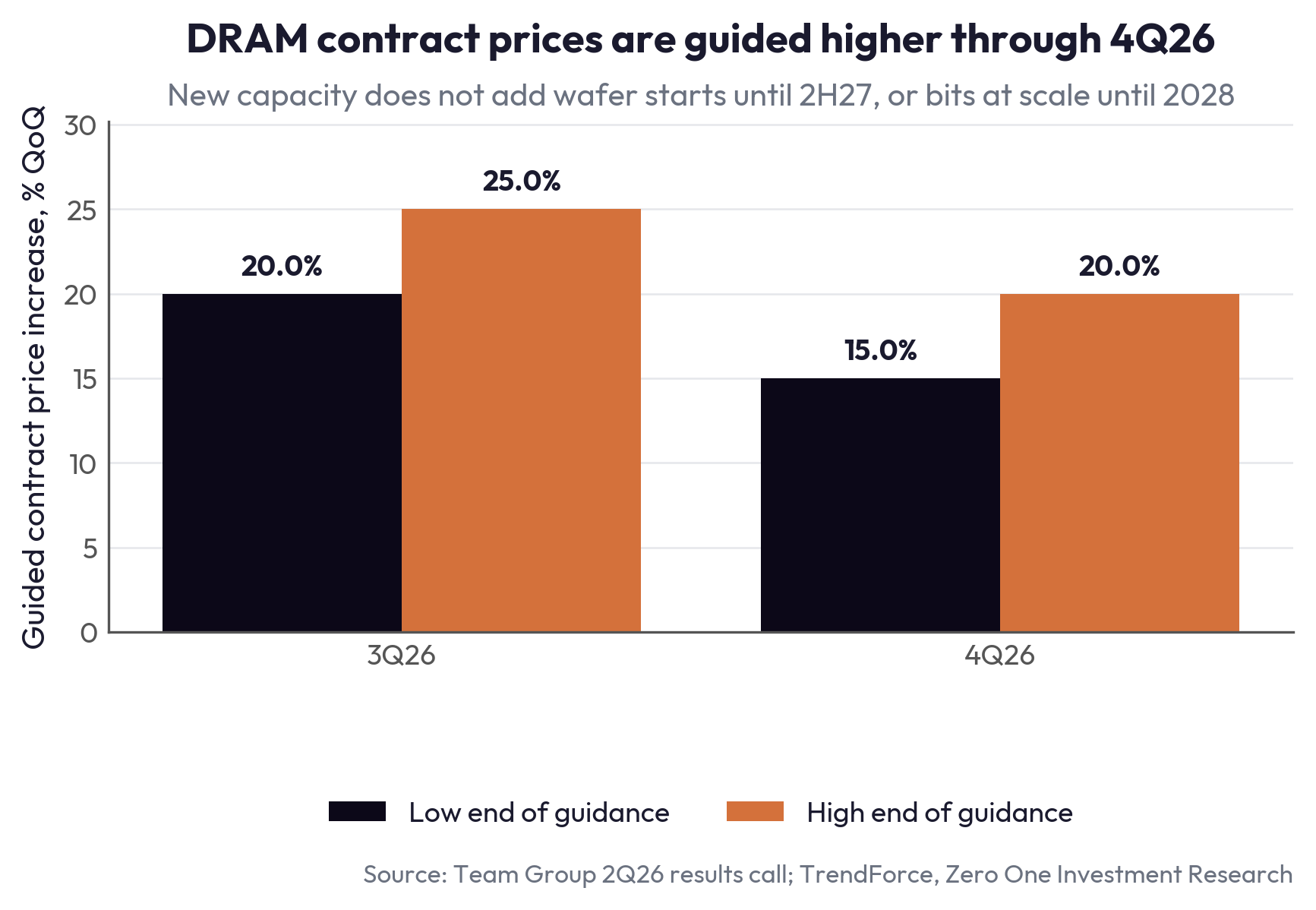
Team Group guides DRAM contract prices up 20% to 25% this quarter and a further 15% to 20% next, which compounds to something close to half again on the price a buyer paid in June. The chart's other half is the part that is missing from it. Citing TrendForce, Team Group said expansion projects add no new wafer starts until the second half of 2027 and no bits at scale until 2028, so nothing on the supply side can answer these increases for roughly two years. That gap is the whole reason a purchasing manager signs a contract running to 2030 rather than waiting for a better price.
Key signal 3
Buyers are pre-paying for 2030 capacity
Why it matters
Winbond's customers already holding 2028 contracts are pressing for agreements into 2030, and SanDisk has committed more than half of its fiscal 2027 supply and about two-thirds of fiscal 2028.
Winbond president Chen Pei-ming told the company's 6 August call that 2027 will be shorter of memory than 2026, and that some customers are asking Winbond to raise prices in exchange for priority supply. Its new Kaohsiung fab breaks ground in January 2027 and delivers output in 2030.
The same behavior is visible outside Taiwan. Per Commercial Times reporting on SanDisk's results call, chief executive David Goeckeler said the company has signed eight multi-year supply agreements averaging more than four years, covering over half of fiscal 2027 supply and roughly two-thirds of fiscal 2028. Its largest customer added demand after signing.
Substrate buyers are further along. NVIDIA, AMD and the hyperscalers hold ABF substrate contracts out to 2028, still cannot cover their requirements, and are asking Taiwanese makers to pull 2029 and 2030 expansion plans forward, consigning equipment and sharing construction costs in exchange for priority.
That is the model that ran in 2021 and 2022. Demand reversed, customers cut orders, and the capacity added afterward left Taiwanese substrate makers in a trough for close to three years. What differs now is that prepayments and profit guarantees sit inside the contracts, and those terms are only tested when growth slows.
Key signal 4
Google's escape from TSMC now depends on Taiwan's substrate makers
Why it matters
Google cannot get enough packaging capacity at TSMC for its 2028 AI chips and is sending 2m to 3m of them to Intel instead, where the weak link is not Intel's own step but the substrate underneath it, running at about half the yield.
Packaging is the stage that assembles finished chips into a working part, and the substrate is the layer underneath that carries the chip and wires it to the board. Google is planning for as many as 15m of its own AI accelerators in 2028, above the 13m-unit annual scale NVIDIA runs today. More than half of TSMC's packaging output for the next three years is already booked by NVIDIA, so Google secured over 10m units there and is routing the rest to Intel.
The reported yields say where that route can fail. Intel's own packaging step runs near 90%, while the substrate beneath it runs near 50%, and a part is only as good as the worst stage it passes through. Unimicron, which makes those substrates, says the work is still early stage and that lifting capacity and yield is its immediate priority. So a decision taken in California now rests on a Taiwanese supplier's yield curve.
TSMC is widening its own bottleneck at the same time. Korea's Electronic Times, relayed by Liberty Times, reported that TSMC plans to move chip-on-wafer bonding capacity to outside assembly and test houses led by ASE, a step it had kept almost entirely in house. TSMC has not confirmed it.
Taiwan's substrate makers are building into the gap. Nan Ya PCB's board approved NT$46.8bn for a large-format substrate plant, its largest investment on record against roughly NT$3bn to NT$4bn of capital spending in 2025. Kinsus plans to lift monthly ABF capacity from about 40m units now to 80m by 2029. Shortages of T-glass fiberglass cloth cap how fast any of it arrives.
Key signal 5
High memory prices are causing retail price hikes
Why it matters
MSI followed Asus and Gigabyte in raising Taiwan graphics card prices by more than 20%, while Raydium's gross margin fell 2.9 points on its best quarter in four years.
Korean brands plan increases of as much as 30% on GeForce RTX 50 cards from August, with the flagship RTX 5090 up about US$1,050 from last month's high. Per TechNews reporting on 7 August, MSI has now followed Asus and Gigabyte in Taiwan, and the increases reach back to the older RTX 30 and Radeon RX 7000 lines. The cards carrying the most memory take the largest increase, which is what a memory bill landing on a shelf looks like rather than a general price rise.
The same cost is compressing margins one tier up. Raydium posted its highest quarterly revenue in four years and its gross margin still fell 2.9 points to 25.7%. Chairman Huang Yu-kuo attributed the revenue to customers pre-building inventory ahead of price increases, and expects the third quarter to slow now that the pre-building is done.
Wistron expects second-half PC shipments to fall 15% for the same reason, while arguing that AI server demand does not move on memory cost because it is not discretionary. That split, discretionary volume falling while contracted volume holds, is the one to carry forward.
Key signal 6
Server rails are earning higher gross margins than even NVIDIA
Why it matters
King Slide reported an 87.42% gross margin on about 90% of the global server rail market, above NVIDIA's, because the lines that make rails are close to full while rack orders grow at triple digits.
King Slide Works makes the sliding rails that hold servers in a rack, a mechanical part with no chip content. Second-quarter net profit was NT$7.088bn, more than ten times higher than a year earlier, and first-half profit already exceeds all of last year.
The margin is a capacity story more than a technology one. Rack demand is running well ahead of the plants that can make rails: GB300 shipments are put at 68,000 racks in 2026, up 172% year over year, while at Fositek, the other Taiwanese rail maker, both the rail and quick-connector lines are close to full and management plans to double them by 2027. A buyer assembling racks this quarter cannot wait for a second source to qualify, so the maker sets the price. Economic Daily News attributes the level to patents and product design in a niche King Slide has largely to itself, and that design position is what lets it hold the price the shortage allows.
King Slide is building to meet it. A Houston plant starts volume production this quarter, a second Taiwan plant comes on line in mid-2027, and two further expansion phases at its Chuan-Yi subsidiary go out to tender by year end.
A margin that far above the rest of the rack holds only while the rail stays a designed-in part rather than a commodity. Two customers are already validating rails from Nan Jun International, with a third close to finishing tests.
Key signal 7
Memory shortages are opening an opportunity for Chinese producers
Why it matters
HP, Asus and Acer have begun using CXMT DRAM in notebooks not sold in the United States, after years in which export policy worked to keep Chinese memory out of Western hardware.
Nikkei Asia, relayed by Tom's Hardware, reported that the three vendors are using small quantities of the Chinese maker's DRAM in a limited number of models. Qualification is the step that matters here, not the volume: it is a multi-month engineering process, and once a part is designed in, the second order is far easier than the first. Acer declined to name suppliers and did not deny the report.
The caution is real. CXMT is listed by the Pentagon as having ties to China's military, and the PC makers are also wary of antagonizing Micron, Samsung and SK Hynix while allocation is scarce.
A separate hedge is contested. Reuters reported that Samsung and SK Hynix have evaluated etch tools from China's AMEC for their China fabs against tighter US controls; Samsung said it has not tested AMEC equipment and never considered doing so, and SK Hynix declined to comment. Neither has ordered tools, so that reporting establishes intent and nothing more.
CXMT has said most of its investment goes to DRAM wafer lines rather than HBM, which points its added capacity at exactly the PC and handset market the AI build is starving.
The past week's rotation: substrate, PCB and memory led while the foundries lagged
The past week's move was a rotation into the bottleneck, not a broad rally. Every one of the largest gainers sits in the layer that is short, substrate, PCB, memory, thermal and rack power, while both Taiwan foundries fell and the Japanese and Korean equipment complex lagged.
The fundamentals did not move the memory names the way the prints implied. Winbond fell more than 5% on 7 August, the session after a record quarter, and SanDisk and Western Digital both fell in the United States after beating estimates. Economic Daily News described the pattern as fundamentals still being revised up while positioning takes profit at highs.
| Company | Ticker | Group | 1-week |
|---|---|---|---|
| Kinsus Interconnect | 3189 TT | IC substrate | +29.61% |
| Aehr Test Systems | AEHR US | Semicap test | +28.87% |
| Jentech Precision | 3653 TT | Thermal | +27.14% |
| Nanya Technology | 2408 TT | Memory | +26.77% |
| CoreWeave | CRWV US | AI cloud | +26.33% |
| Winbond | 2344 TT | Memory | +25.77% |
| Advanced Energy Solution | 6781 TT | Server power | +25.00% |
| Gold Circuit Electronics | 2368 TT | PCB | +23.83% |
| Fositek | 6805 TT | AI rails and connectors | +23.70% |
| Compeq Manufacturing | 2313 TT | PCB | +23.37% |
| Alchip | 3661 TT | ASIC design service | +21.41% |
| Unimicron Technology | 3037 TT | Substrate and PCB | +21.35% |
| Hanmi Semiconductor | 042700 KS | Semicap equipment | -10.35% |
| UMC | 2303 TT | Foundry | -4.13% |
| TSMC | 2330 TT | Foundry | -2.27% |
| Murata Manufacturing | 6981 JT | Passives | -2.06% |
| Tokyo Electron | 8035 JT | Semicap equipment | -1.80% |
| Visera Technologies | 6789 TT | Image sensor test | -1.53% |
| Lasertec | 6920 JT | Semicap inspection | -1.19% |
| Advantest | 6857 JT | Semicap test | -0.95% |
Ranked by one-week change; prices as of the Friday, 7 August 2026 close, which is the last bar in every market shown. Coverage names outside the technology supply chain are excluded. Advanced Energy Solution builds battery backup units for AI server racks, and Fositek makes AI server rails and liquid cooling quick connectors. Hanmi Semiconductor, named a week earlier among the Korean back-end suppliers positioned to benefit first from TSMC's reported outsourcing of chip-on-wafer bonding, was the largest decliner. Source: Zero One Investment Research.
Week Ahead / What to Watch
- Taiwan July revenue filings (due 10 August) Every Taiwan-listed company files July revenue by the 10th, the direct test of whether the memory and substrate price increases reached the rest of the chain or stopped at the makers.
- Powerchip 2Q26 results (11 August) The foundry that just signed long-term capacity away to AP Memory reports into a market where memory and logic compete for the same 12-inch wafers.
- Foxconn 2Q26 investor conference (12 August) First management commentary since July revenue crossed NT$900bn, and the clearest read on whether the DRAM shortage stranding Apple silicon at TSMC is reaching iPhone 18 assembly schedules.
- Applied Materials FY3Q26 results (13 August) Winbond's 2027 fab, Nanya's EUV commitment and the WSTS forecast either show up as equipment bookings now or they do not.